Tuesday, October 18, 2005

Six months from now...

Most people can't write, I know I can barely string a sentence together but I know good prose when I see it and this is good prose. By HarrangueMan who can leave a comment if he objects to his work being reproduced here. If you do object, let me know and I'll just link to it, I thought about that but most people will just look at the link and not click, which is crap.

Six months from now...

Achmed sat alone in the cell and contemplated sleep. Or rather the lack there of. The fluoros had been burning since he'd been thrown in the cell some 12 days ago. At least, he thought it was 12 days. Because he sat without a watch, and without pen, with no idea how much time had passed.

He was so tired, his eyes puffy with fatigue. The light burned into his eyes and, for a second, he thought he was back in Gaza in the high heat of the day.

Gaza, I'm not in Gaza, I'm in Melbourne he reminded himself.

He'd come here as a child, and was now 24. He'd been working 12 day fortnights, having signed an AWA that removed penalties, annual leave, loading, and all manner of rights because that was the same for all the menial jobs he, having poor English, was able to get. They did get marginally more money per hour – well – at first – until the revised AWA had lowered the hourly rate because the companies' profit forecast had come in at only 12%.

'We all have to tighten out belts,' had said the manager, pulling his trousers up over his ample stomach as if to reinforce the point. It was okay for him. His AWA had a performance bonus built in because the manager was tight with the HR people at head office. They'd started together, and kept an eye out for ways of improving their lot without the benefit of collective bargaining to assist them.

The moth battered itself forlornly at the fluoro light. Achmed smiled despite himself and his position.

He'd been over his story a hundred times he thought when the state police turned up in the company of an ASIO officer. They'd showed him a picture of his brother, from back in Gaza. His brother was a member of Hezbollah, as were thousands of other dispossessed, angry young men. He'd gone over there from Australia to participate in the forming Palestinian state. Achmed had begged him not to.

'Don't do it,' he'd said. 'Palestine may be where our people came from, but Australia is your home now.'

But his brother was head strong and off he'd gone. And two weeks ago he'd called asking for money. Achmed had given it. That's what family does.

It turns out his brother gave the money to Hezbollah, to secure himself a ranking position in the organization. And to protect the small gym he ran for the children from being abandoned by the organization. Hezbollah may have twisted the tenements of Islam, and be conducting a stupid war against an implacable enemy, but for many Palestinians, they were the only organization capable of providing any measure of facilities, youth groups, even food, with a hopelessly corrupt Authority trying to protect its monopoly on power. How much money had Arafat secured away in Swiss bank accounts. One billion, two? Money from the US and Europe meant for reconstruction, but siphoned off instead. No wonder he'd not wanted peace. It would have destroyed his money-making enterprise.

So now Achmed sat in his cell, waiting for the interrogators to bring him back in once again. And they who were convinced he'd been supporting a terror group. That was a life sentence if he was convicted. If? Try when, he thought morosely

He had four interrogators now. Two women, two men. All very polite. All asking the same questions about his brother again and again and again. He'd asked to speak to his mother, to let him know he was safe. And they'd let him call her – but he couldn't say where he was, or what was happening. Because that was against the law – punishable by five years jail. Let along the life sentence they said he now faced for giving his brother the money. When the call had been ended by the unsmiling policeman, his mother had been screaming.

He rubbed his eyes and watched the moth batter itself against the light. He knew he didn't have a job any more, even if he got out. The AWA stipulated that more than three days absence without prior agreement resulted in termination. And the boss didn't like Achmed. Not after he'd seen the boss loading his car boot with produce from the market.

The shutter opened. It did so now and then. To see what he was doing. Why wouldn't they just watch him through the camera that recorded his every move? Who knows. They didn't answer any of his questions. They didn't have to.

'Relaxed mate?' said a voice from the shutter. 'Comfortable?'

'Please, I've said all I know,' said Achmed.

'The interrogators are back mate. I'll be down for ya in five minutes.'

'Can you tell me the time?' asked Achmed. 'And the date?'

The shutter closed, the guard not answering.

Achmed sat and watched the moth dance, and thought stupidly for a moment he was watching a bird in the sky, over the brown hills of Palestine.

HarrangueMan

Marlboro Men


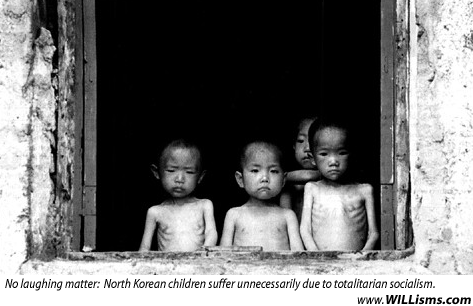
Tobacco giant capitalises on North Korean regime

By Ian Cobain and David Leigh in London
October 18, 2005

the world's second-largest cigarette company, has been secretly operating a factory in North Korea for the past four years.

The company opened the plant in a joint venture with a state-owned corporation shortly before the North Korean regime was denounced by the US President, George Bush, as a member of the "axis of evil", and despite widespread concern over the nation's human rights record.

BAT has never mentioned the factory in its annual accounts.

The discovery of the secret factory comes two years after BAT was forced to pull out of Burma, under pressure from the British Government and human rights campaigners.

The anti-smoking group ASH said: "It seems that there is no regime so awful and no country so repressive that BAT does not want to do business there."

BAT launched its business in North Korea in September 2001 after forming a joint-venture company with a state-owned enterprise called the Korea Sogyong Trading Corporation, whose main interest had previously been exporting carpets.

BAT made an initial investment of $US7.1 million in the enterprise and owns 60 per cent of the company formed, known as Taesong-BAT. BAT has since increased its investment but declines to say by how much.

Taesong-BAT employs 200 people at its factory in Pyongyang, producing up to 2 billion cigarettes a year. Despite its previous involvement in smuggling, BAT denies any of the cigarettes are intended for China, insisting they are all for North Korean consumption.

The company says it has worked to improve the working conditions of its employees in Pyongyang, that it provides workers with free meals, and that they are "well paid".

Questioned about its apparent reluctance to disclose the existence of its North Korean operation, BAT said it listed only its "principal subsidiaries" in its accounts, and added that it was not obliged to inform investors about an investment of that size.

The spokeswoman denied the factory was a secret: "If we are asked about our investment there, we respond appropriately. The investor community know of it."

Asked about North Korea's human rights record, the spokeswoman said: "It is not for us to interfere with the way governments run countries." She said BAT could "lead by example" and assist the country's development by meeting internationally accepted standards of businesses practice and corporate social responsibility.

In launching its North Korean enterprise, however, BAT is doing business in a country regarded by some as having the worst human rights record in the world. Even one of BAT's own public relations officers, in Japan, was astonished when asked about the joint venture. "Business with North Korea?" he asked. "Where there are no human rights?"

Last August, in an excoriating report to the United Nations General Assembly, Vitit Muntarbhorn, special rapporteur on North Korea for the UN Commissioner on Human Rights, pointed to the "myriad publications" detailing violence against detainees. According to human rights observers in South Korea, about 200,000 people are held as political prisoners in the north.

Human Rights Watch describes the Pyongyang regime as being "among the world's most repressive governments".

The Guardian


British American Tobacco PLC's Brown & Williamson unit and R.J. Reynolds Tobacco Holdings Inc. are also well-positioned. Both companies are represented by Barbour, Griffith & Rogers, a lobbying firm stocked with Republican operatives, including former GOP Chairman Haley Barbour and Lanny Griffith, a former White House aide to Mr. Bush's father.

The industry's first objective is to get rid of a massive federal lawsuit, launched by the Clinton administration, that accuses cigarette makers of "racketeering" and lying about the health risks of smoking for 50 years. The case is pending in federal court in Washington.

Tobacco companies are so confident the Bush team will drop the suit that they claim to have no plans even to ask for it to be withdrawn. "We are not lobbying on this at all," says Philip Morris spokeswoman Peggy Roberts. Many in the industry say they think an aggressive push to kill the suit would be counterproductive, causing the Bush administration to worry about the perception that it is eager to do a huge favor for one of its most-generous donors.


Corporate Donors Seek Return On Investment in Bush Campaign

Bush ended with an attack on North Korean dictator Kim Jong Il. 'He's starving his own people,' Bush said, and imprisoning intellectuals in 'a Gulag the size of Houston.' The president called him a 'pygmy' and compared him to 'a spoiled child at a dinner table.'

Newsweek
"I Sniff Some Politics"
May 27, 2002


I'm Sure BAT will become pariahs for doing business with the last Stalinist state on earth.

Monday, October 17, 2005

On Tax


Click here for a larger image.

Are you more free if your government cuts education and health funding and instead returns your taxes to you in a most literal example of redistribution?

Or are you more free if your government takes your money but instead uses it to provide you with skills that make you competitive in the job market and invests in your earning potential (medicare etc.)?

Of the two compromises I'm inclined to prefer the latter, simply because it enhances the freedom of individuals. I view socialised healthcare and education as individuals pooling resources to accomplish something they wouldn't otherwise be able to and reaping the benefits. More skills + job market clout = higher pay. Higher pay = more disposable income to spend on stuff. More spending by individuals = more jobs.

This addresses the inevitable argument that if someone doesn't use a service, like healthcare for example, why should they pay for it? The obvious answer would be that they pay to keep it accessible. For an individual to pay for their healthcare needs would require prohibitive amounts of personal income (to accumulate as a hedge against future healthcare needs), which could be otherwise directed towards spending to keep the economy going.

Why should rich people pay more tax? Simply because in our society the richer you are the more of use you make of societies provisions. Wealthy individuals work hard for their wealth but what use does a poor person have for guaranteed investments or a government regulated property insurance market? Precious little. A tax system should give people the freedom to improve themselves and you can't do that by taking money from poor people. On the other hand those that make themselves wealthy without private armies and a personal economy and financial system should keep in mind that there ain't no such thing as a free lunch. It might just have looked that way on your way up.

Realistically a person who earns $30,000 and pays $3,000 in tax is far less able to spend their $27,000 in ways that expand a service economy. They have to look after their immediate needs first before eating out or watching a movie. On the other hand a person who earns $300,000 and pays $100,000 in tax is still able to do a great deal of discretionary spending, or saving and investing with the $200,000 left over. Obviously these are extreme examples but they illustrate my point.

Points for civilised discussion I hope.

Sunday, October 16, 2005

You Taggin' me?


'Cos I'm the only one here...

20 facts about me.

1) I'm nerdy, i like computers and starwars.

2) I'm sporty, compete with me over a ball and you might get hurt.

3) I think these lists are preposterously narcissistic and I'm cringing in shame right now.

4) Blogging is narcissistic too, I try and avoid turning my blog into a self indulgent wank.

5) I'm not a leftwinger, sorry if I fooled you.

6) I can best be described as a libertarian with social democrat leanings.

7) Lefties often scare me. A lot of them have less than a passing regard for individual rights.

8) I think individual rights can be collectivised without being diminished however.

9) I think about politics way too much.

10) I should have done political science at uni, but when I meet someone who did, I'm ususally glad I didn't.

11) I know how lucky I am compared to most people, I think some people need to think about that every now and then.

12) I hate discussing or referring to myself in a public manner.

13) The first album I ever owned was Def Leppard's Adrenalize, on tape.

14) The second was The Prodigy's Fat of the land.

15) The last album I bought was the Killers' Hot fuss, which totally kicks Franz Ferdinand's dissapointing ass.

16) The latest Foo Fighters album is a tragic disappointment.

17) I'm convinced that music is dying. Being killed by retarded music company executives.

18) Pretty much all current music sucks ass.

19) I'm amazed I got to 20 things.

20) No, I don't think you need to know more about me, mind your own business.

I'm tagging Mikey, mostly because he reminded me a little of Snell, drummer for The Towers of London (short guy in the middle).

Saturday, October 15, 2005

Domestic Terrorism


Bastard.

Terrorist laws to lock up objectors


Supporting the insurgency in Iraq, Afghanistan or any country where Australian troops are deployed could carry a penalty of seven years' jail under the Prime Minister's new terrorism laws.

The changes also allow for control orders of unlimited duration, secret preventive detention, the monitoring of lawyers, and life imprisonment for funding terrorist organisations.

The draft legislation, disclosed by by Greens yesterday, details the far-reaching security regime proposed by John Howard for "very dangerous and difficult and threatening circumstances" in the wake of the London bombings.

New sedition offences will put big constraints on anti-war protests, familiar since the Vietnam era, and come down hard on those advocating violence against any religious, national or political group.

Those charged with sedition can argue they were acting "in good faith" but it is unclear how the courts will interpret this.

The bill sets out new federal police powers to detain terrorist suspects for up to 24 hours, and up to 48 hours with the approval of a judge or magistrate. Suspects will get access to a lawyer to challenge the detention order in a court or complain of maltreatment.

Police do not need to give suspects or their lawyers reasons for the detentions and can monitor lawyers. All conversations lawyers have with their clients must be in English or translated into English for the police. Police are prohibited from questioning the detainees but that ban does not apply to ASIO officers.

Last month the states agreed to allow extensions of up to 14 days for detentions when a terrorist act is believed imminent. The suspect must then be released if no terrorist act occurs.

Detentions are secret but suspects are allowed to contact a family member or employers to say they are safe but, "not able to be contacted for the time being". If they disclose the detention they can be jailed for up to five years.

Under the bill, the Government can apply to a court for control orders on terrorist suspects who have not been charged. These orders include house arrest, preventing them using the telephone or internet and restricting their social contacts and work opportunities. Suspects can also be fitted with tracking devices.

The suspect's lawyer can be shown the control order but not necessarily the evidence or reasons behind it.

The orders can last up to 12 months and can then be renewed any number of times.

Persons under control orders may be given "counselling or education" if they agree.

The bill does limit to three months control orders on those aged between 16 and 18.

Also contained in the legislation are wide-ranging search powers that will compel the production of any documents relating to "any serious offence", regardless of any laws protecting privacy or legal privilege.,

The new laws are to be debated this month, after the Labor premiers agreed to their broad outline at the recent terrorism summit in Canberra.

The proposed laws have been strongly criticised by human rights lawyers and some Muslim leaders, who have described them as draconian.

The premiers and Mr Howard insist the new laws contain sufficient safeguards to ensure they are not abused.

Because everyone knows the government can be trusted not to abuse its power, right?

These are Apartheid laws. I wish I was being hyperbolic, but they really are. Detention without trial, banning of suspects (the old SA govt. only banned people who were convicted, preventing them from meeting people etc.) Even cops listening in on lawyers is straight from the old SAP playbook. They used to do it to Nelson Mandela for fuck's sake. I'm simply disgusted. I assumed my contempt and loathing for our miserable cockroach of a PM could go no lower, how wrong I was. Imagine crimialising support for people resisting our illegal invasion, something which is their inalienable right, enshrined in the Geneva convention.

The rodent's war is all cost, all cost, and all of it borne by you and I. That's Howard style 'conservativism'. Dickhead.

Thursday, October 13, 2005

Spineless

PM gets personal: Beazley's got no ticker

John Howard  says Kim Beazley has failed to develop a persona.

John Howard says Kim Beazley has failed to develop a persona.
Photo: Penny Bradfield

Prime Minister John Howard has launched a stinging personal attack on Kim Beazley, saying he doesn't have the ticker to be a leader.

Mr Howard has told Parliament that he once thought Mr Beazley would be an effective opposition leader.

But he says the Labor leader has failed to develop a persona and let the Australian people know what he stands for in 9½ years.

"I thought at one stage he did represent an alternative leader of the Labor movement in this country," Mr Howard told Parliament.

"But I've watched him over 9½ years. He does not, Mr Speaker, have the ticker."

Mr Howard launched his attack after Mr Beazley described the Government's advertising campaign for its industrial relations changes as the "soft soap" covering the twisting knife underneath.

"The Leader of the Opposition's greatest problem is that he doesn't stand for anything," Mr Howard said.

"He will never go out to the Australian community and argue a consistent proposition.

"Stretch back over 9½ years - can you think of one thing that the Leader of the Opposition has put forward?

"He's had 9½ years to devise a persona. He's had 9½ years to tell the Australian people what he stands for.

"The only thing that can be said of the Leader of the Opposition is that if the Coalition is in favour of it, the Leader of the Opposition is against it."

Mr Howard said Mr Beazley had failed to build a case against the Government in the four days since the industrial relations changes had been unveiled.

"He's failed again for the same reason that he's failed over the last 9½ years," he said.

Mr Beazley later described it as an uncharacteristic spasm of hatred from Mr Howard, accusing him of dribbling and spitting as he delivered the insult.

In 1998, Mr Howard publicly questioned whether Mr Beazley had the ticker to be leader.


I don't know which is worse, that it's true, or that I actually agree with Howard. I think I'll go throw up now.

A gold star and the recognition of your peers for anyone who can state, in one sentence exactly what Kim Beazley stands for. Even if it's just for this week. It's just positions of convenience followed by embarrassing climb downs for Beazley.

Wednesday, October 12, 2005

Tuesday, October 11, 2005

Intelligent Design for Economics


Gerard Henderson,
Executive Director of the Sydney Institute for not Fact Checking and Imaginary Economic Fairy Theory

Making a job of IR reform

The Catholic Church is wide of the mark with its criticism of plans for the workplace, writes Gerard Henderson.

It was a pause, replete with meaning. During her interview with John Howard on the ABC Radio AM program yesterday, Catherine McGrath adopted her familiar stance of an advocate rather than a genuine inquirer. She put it to the Prime Minister that "Sweden, Norway, Iceland, Denmark have highly regulated labour markets but have higher productivity and higher wealth per capita than Australia".

Howard responded: "Well, what about jobs?" There was a long pause before McGrath raised the issue of Germany and made an unclear point about the collapse of the Berlin Wall. Certainly Sweden, Norway and Denmark have better employment outcomes than most of the OECD economies in continental Europe. Yet unemployment in all these nations has increased since 2002. This contrasts with the US, Britain, Australia and New Zealand, which have less regulated industrial relations systems and where unemployment has declined over the past three years.


So what are those unemployment rates? Norway, 4.3%, Denmark, 5.7%, Sweden, less than 5.5%. They also manage to have free tertiary education and all employees enjoy a minimum of 5 weeks paid leave anually. There's a dime's worth of difference between the per capita GDP of Sweden and Australia, which has half our population. It's called Google, Gerard, I'm sure the "Sydney Institute" has internet, clicky clicky.

In any event, the stark contrast within the OECD is between the US and Britain on the one hand and Germany and France on the other. Unemployment in Germany is close to 12 per cent and the figure for France is 10 per cent, compared with 5 per cent in the US and under 5 per cent in Britain. The relevant figures for Australia and New Zealand are 5 per cent and about 4 per cent, respectively.

The message is indisputably clear. Less regulated labour markets contribute to employment growth. More regulated labour markets are invariably associated with high unemployment. Even so, the message from the Howard Government's document Workchoices: A New Workplace Relations System, which was released by the Prime Minister and the Workplace Relations Minister, Kevin Andrews, on Sunday, will not be easy to sell within the electorate.


Er, no, there's no clear message. For example, Portugal, the poorest nation in the EU has a 2.5% unemployment rate. Switzerland, which has a typically European economy also has an unemployment rate of less than 3%. Ditto Luxembourg and the Netherlands. To claim to divine some sort of economic truth from a single statistic would be, well talking out of one's ass.

As Peter Costello remarked previously, Australians don't march in the streets for economic reform. A majority of Australians have accepted the necessity for reform over the past two decades, but that's about it. Then there is the fact that opinion leaders and commentators tend to favour more regulated labour markets. This is the case with many employees in the media, academics, schoolteachers and public servants along with religious institutions.

Take the Australian Catholic Commission for Employment Relations, for example. It recently released a critique on the Howard Government's industrial relations reform agenda, which it claims spells out "Catholic social teaching". In the introduction, a distinction is drawn between the "social model" and the "market model" in Europe. The clear implication in this paper is that the former is more in line with Catholic social theory than the latter. Maybe so. What the author of the document fails to point out is that unemployment is twice as high in "social model" nations (for example, France) than in "market model" societies (for example, Britain).


True, but they also have higher levels of illiteracy and higher poverty rates. While full unemployment might be great, there are other factors that make a country livable.

In Online Catholics (issue 58, June 29, 2005) Neil Ormerod declared that "it is difficult to see how Kevin Andrews reconciles his workplace reforms with his Catholic faith". Ormerod is professor of theology at the Australian Catholic University in Sydney. In the same issue, James Macken (a former judge of the NSW Industrial Relations Commission) wrote that the Howard Government's agenda is "contrary to Catholic teaching".

How odd. It is difficult to imagine Online Catholics running two articles in a single issue criticising Catholics for not following traditional Catholic teaching on, say, birth control or divorce. Also, why is it contrary to Catholic social teaching for the likes of Andrews to be advocating outcomes which encourage job creation along with a decline in unemployment?


How odd. Gerard doesn't deign to tell us precisely how these reforms will encourage job creation and reduce unemployment, rather than encourage employers to force existing employees into casual-like status instead of hiring more. Is he seriously suggesting that because people can hire workers for less they'll just hire more of them? Why not just pay the ones you've got less and increase profits? No wonder he runs a think tank, you couldn't trust Henderson to run a lemonade stand. But then this appears to be a man who went straight from university to a life of political hackery before slowly settling to professional toadying for influential business interests.

Interviewed on the ABC Radio National Breakfast program on August 9, the executive officer of the Australian Catholic Commission for Employment Relations, John Ryan, opposed the proposed changes to the unfair dismissal laws. Ryan maintained that "small business employers don't have a problem with recruitment" because they "engage people as casuals or as contractors". In other words, he acknowledged that the existing legislation discourages small businesses from recruiting permanent employees but believes that such a situation is more in line with Catholic social theory than the Howard Government's reform agenda in this area. Quite bizarre, really.

Nonsense, every employer wants to pay as little as possible for labour, just like every consumer wants to pay as little as possible for products. The fact that employers prefer casual arrangements is simply illustrative of the fact that casual arrangements offer far less value for workers than full time arrangements, duh. Really, how stupid. Businesses are driven to maximise profits, not hire full time employees. It's moronic to suggest that allowing businesses to minimise labour costs will lead to more employment. If I have 10 workers meeting my output needs why would I hire 5 more? Out of the goodness of my heart? If I need more workers to increase my volume wouldn't I just, gasp, pay the market price of the labour I wanted? I mean, fuck, I'd love a new Xbox but you don't see me whinging to nanny government to force Microsoft to change its pricing to make the market more attractive to me. If I can't afford it, I just don't buy it, perhaps enough people will feel the same and Microsoft will lower their prices to sell more Xbox. Wow, that must be that invisible hand thing.

The Catholic Church is not alone in its support for a more regulated industrial relations system.

In July, Archbishop Phillip Aspinall, the newly elected Anglican primate, said he might even man a picket line in support of trade union opposition to the Coalition's reform agenda. He was particularly critical of likely changes to the existing unfair dismissal legislation. This despite the fact that such Labor MPs as Kim Beazley, Stephen Smith and Tony Burke have acknowledged that there are some problems with the existing system - as has the ACTU secretary, Greg Combet.

Industrial relations reform has seldom been popular. This was true of the Keating Labor government's legislation in 1993 and of the Howard Government's first attempt at reform in 1996. However, both reform packages contributed significantly to Australia's fine economic performance over the past 15 years.


Paul Keating was able to advance a credible, cogent economic argument for his reforms. John Howard's proposed market distortions have only the support of partisan hacks paid for by the business community, I haven't seen a credible economist evince a mechanism, let alone a theory by which this heavy handed intervention can possibly succeed. Of course it's very easy to advocate the erosion of workers' bargaining power from Henderson's position, lapdogs never have to bargain with their masters.

Told You

Iraqi violence hits new peak for British troops.

Couldn't have seen that one coming eh?

Sunday, October 09, 2005

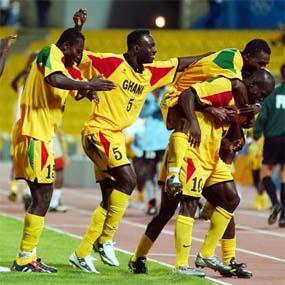
GHANA QUALIFY!


Michael Essien


We're in the World Cup! We're in the World Cup! Wahooo!

Now if Australia make it too things'll be perfect, as long as Ghana don't play them.


YAY!!

Saturday, October 08, 2005

Insane in the Membrane


"God told me to strike at al-Qaeda and I struck them, and then he instructed me to strike at Saddam, which I did, and now I am determined to solve the problem in the Middle East. If you help me I will act, and if not, the elections will come and I will have to focus on them."
George W Bush to Palestinian PM Mahmoud Abbas

I for one am gratified that American people saw fit to elect someone who's batshit insane as Planetary Emperor. What better place for someone who believes that god speaks to them and directs their actions than in charge of weapons designed to bring about the apocalypse.

Thursday, October 06, 2005

$300 Billion to change mullahs


What do you mean, 'you haven't noticed any difference'!?
Get back in the house before I whip you!


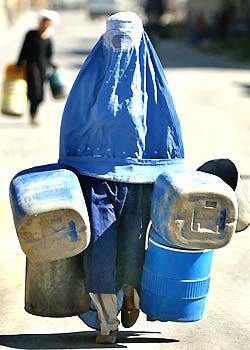
Women's rights were constantly referred to as a justification for bombing women and children in Afghanistan to free them from the strictures of Sharia law. Many years and a pile of corpses later:

Afghan editor arrested for 'unIslamic' articles

Press Trust of India
Kabul, October 4, 2005, 20:56 IST

The editor of an Afghan women's rights magazine has been arrested and thrown in Kabul jail after he was accused by a presidential adviser of publishing unIslamic material, officials said today.

Minority Shiite Muslim clerics in Kabul objected to two articles in the monthly Haqooq-i-Zan, or Women's Rights, edited by Ali Mohaqiq Nasab, that were critical of Islamic law. Police arrested Nasab on Saturday.

Late last week, the clerics approached Mohaiuddin Baluch, religious adviser to President Hamid Karzai, who said he forwarded the magazines to the Supreme Court.

"I took the two magazines and spoke to Supreme Court chief, who wrote to attorney general to investigate," Baluch told The Associated Press.

He said one of articles was critical of the punishment under Shariah, or Islamic law, of 100 lashes for those guilty of adultery. Another article argued that giving up Islam was not a crime. Baluch said that was directly against Quran.


Emphasis mine.

Well, glad to see that was all worth it in the end.

The Book of Job


Finally bought the book, I was getting sick of being told what was in it by people who obviously hadn't read it. It's a pretty good read, I've decided to to try and excerpt the interesting bits, the insights into the political minds of Labor party leaders, not the junk that's been washing over the news. Here's the first one, feel free to bang on about it in the comments.

Monday, 27 May -1996

Beazley tells the Shadow Ministry that 'Opposition is all about pissing on them and pissing off'-a hit and run style of politics. He sees our political recovery hinging on the exploitation of the Government's failings and public discontent, issue by issue. I've got that sinking feeling that, for all his rhetoric, Kim is not going to deliver a new, modern Labor agenda. That's his philosophy: piss on them and then piss off.
It will never suffice. Even in Opposition, a political party needs a philisophy of government, a set of ideas that inspires our supporters and gives the show some purpose beyond an opportunistic grab for power. At the end of the day, on the big things really count. It's the cause, comrades, it's the cause that matters.
If you listen to the debates and amendments in Federal Parliament, all they are doing is tinkering at the edges with the trademarks established by Keating on economic policy, and by Whitlam and Howe on social policy. The only people who make a difference in this place are the agenda-setters.

Prescient words. Ten years after they were written, the interaction between Beazley and Howard hasn't changed. Howard tinkers with a policy he inherited, Beazley roars in outrage and spews bombast, hoping to capitalise on public discontent. Neither of them have any plans beyond remaining in power or snatching that power from the other. Beazley's like a dog chasing cars, no idea what to do if he ever catches one.

Tuesday, October 04, 2005

The Sound of Peace


A pacified Iraqi village.

Operation "Iron Fist", an assault on the Iraqi village of Sadah has been underway for a few days. 1000 marines cut off a village of 2000 people, bombed it and are now sweeping (just like in Vietnam) the village in search of 'insurgents' who, surprisingly, are nowhere to be found, again.

Since there are only 2,000 inhabitants of Sadah on a good day (it is a tiny border settlement near Syria northwest of Baghdad), the Marines have a certain advantage. You figure half of Sadah is women. Some further proportion is boys too young to fight and old men. Could they muster 300 local fighters (would all of them be in the guerrilla movement)? And how many foreign jihadis could live in a town of 2,000? Would you guess 50? So have we thrown 1,000 Marines at between 50 and 300 local fighters, who are poorly armed and lack real organization? Meanwhile entire districts of Baghdad, a city of 5 or 6 million, are controlled by the guerrillas. Wouldn't they be a bigger priority, since 95 percent of the violence in Iraq is plotted out by Iraqis?

This operation strikes me as odd. Perhaps they think a high-value target like Zarqawi is there, and the thousand Marines are to make sure that he does not escape?
Personally, I'm not sure Zarqawi exists, so I'd be reluctant to send a thousand Marines after him and to majorly inconvenience (and from the video on Aljazeerah, partially flatten) poor little Sadah.
Juan Cole

Well of course. The casualty shy US would never actually assault a well defended target with infantry without flattening it first, despite the fact that it would kill fewer Iraqis and probably deny any actual insurgents the many days of warning a sustained bombing campaign provides. Some of them might get killed, what do you think this is, a war?

The New York times reports that in an effort to placate an angry crowd a US colonel said:

"Some of you are concerned about the attack helicopters and mortar fire, I will tell you this: those are the sounds of peace."
The silence of the grave.

Monday, October 03, 2005

Bali is a Theme Park!


I am an asshole, by Paul Sheehan.

The Sydney Morning Herald pays me good money to talk out of my ass. Harken unto the flapping of my asscheeks!

It is difficult to imagine the strong relationship between Bali and Australia surviving this latest outrage after the battering it has received since the first blow was delivered on October 12, 2002, when 88 Australians were among the hundreds killed and maimed by Islamic terrorism. The timing of Saturday's co-ordinated attack was without question a macabre anniversary of the 2002 event. So was the attempted destruction of the Australian embassy in Jakarta on September 9 last year.

Since then have come the hammer blows of the tsunami, which caused havoc not just to much of the Sumatra coastline but to all of Indonesia's reputation as a tourist destination. There has been the made-for-television Schapelle Corby saga, which caused real damage to Indonesia's standing with Australians. Then came the arrest of nine Australians for drug smuggling, the "Bali nine", with the likelihood that the alleged ring-leaders will be sentenced to death.

The Boxing day Tsunami, terrorists who blow up Balinese because we invaded Iraq, Schapelle Corby smuggling drugs and 9 morons with the contents of Keith Moon's liver strapped to their bodies are all really the fault of... The Balinese!

Then this: on May 28, the front page of The Daily Telegraph ran a photo of Abu Bakir Bashir beside a banner headline that thundered: "NATION'S FURY - This terrorist planned the murder of 88 Australians and got two years. Yesterday, Schapelle Corby got 20."

That just about summed up the mood.

"I are two stupid to watch teh TV! Paul Sheehan! Paaaul Sheeeehan!"

In August, another young Australian beauty, Michelle Leslie, was thrown into a Bali jail for drug possession. Now Bali Bombings II, three bombs instead of two, with more young Australians among the dozens minced by ball-bearings. The word "Bali" has lost the connotation of tropical escapism that it enjoyed for 50 years. Australians kept coming back after the bombings in 2002, after the tsunami, after Corby's ordeal, but surely the flow will fall back to a trickle again, perhaps this time for a long time.

"Bali" now brings to mind drugs, death and danger. The Balinese will pay doubly for all this.

Yes, doubtless some Balinese prostitute will be denied the heaving, sweaty bulk of Sheehan looming over him/her.* "Stupid Balinese. Make your island back into a tropical paradise so I can visit!! Move oompa loompas! scurry, scurry for Paul Sheehan! Block out the reality I support!"

Yesterday, the Prime Minister, John Howard, was saying the right things, but for all his talk about national security, for all the cost of new security initiatives, for all the compromises involved in the new security laws, all is undermined by the Howard Government's intimate involvement in the military adventures of President George Bush in the Middle East. Australia has become a higher target for terrorism. This is self-evident. It is part of John Howard's legacy.

So wait, Iraq has some part to play in this? It's not all the fault of the Balinese? So what does Paul have to say about the man whose legacy is the endangering of Australian lives for no benefit whatsoever?

Howard is, however, a lucky politician. For 10 years, he has been aided by the hysteria and ineptitude of his ideological enemies, who have constantly invented causes to attack him which have merely served to strengthen him. Out in the Australian electorate, the deafening campaign on behalf of illegal immigration was dead on arrival. The hysteria over Iraq was dead on arrival. The fetish over the Taliban sympathisers in Guantanamo Bay was dead on arrival. The latest concocted outrage, the hysteria over new anti-terrorism laws, has just fallen at Parliament's door - dead on arrival.

"Paul Sheehan like torture! Paul Sheehan go to Bali, make pyramid with Indonesians!"

We have to stand with President Susilo Bambang Yudhoyono. We have to stand with the Balinese. We need more and stronger links to Indonesia.


Except by actually going there, or, like, obeying their drug laws. Or not doing things that make people want to kill Balinese to get to us.

Paul Sheehan ladies and gentlemen.

*This is merely hyperbole, for all I know Mr Sheehan doesn't actually visit prostitutes. In fact he may never have visited a prostitute in his life. If however any prostitutes contact me regarding having sex (ugh) with Mr Sheehan I will doubtless take this down and replace it with something more suitable. Like a billboard.

Another Bombing

I haven't posted about the latest demonstration that we're winning the war on Turr®, because Sarah has said everything I want to say far more eloquently and because it makes me angry when I think about how our asshole of a PM's brilliant policy re: Iraq is measured by a godawful pile of corpses. This is what we wanted, I hope it meets everyone's expectations. This is the face of victory.

Australians think terrorism is like the weather. Terrorists scream at us that they're trying to kill us because we invade Muslim countries and kill their inhabitants for no good reason and John Howards argues with them about their motivations. "I kill you all becaus of Iraq!!" "No no, you don't mean that, you're just saying that as an excuse to kill for no reason." A look at the letters page of any newspaper will tell you that apparently being 'strong' and 'positive' is enough protection against explosively projected ball bearings.

As usual a look to history indicates things will only get worse. When terrorists initiate a campaign against a country to achieve a political objective they always begin by targetting the country outside its borders. The first IRA bombing were carried out in Ireland. The first Hizbollah bombings were carried out in Lebanon and the first PLO bombings were carried out in the occupied territories. Attacks on the target's home soil took place after the initial attacks failed to make an impression. Our government is already telling us that a terrorist attack in Australia is 'inevitable' yet it wasn't inevitable in the 1990's when we intervened in East Timor. Our government is basically saying that people are going to try to kill us because of policies a majority of Australians don't support and have resulted in nothing but a mountain of dead bodies. They aren't going to change these policies and, by the way, they can't protect us from their inevitable consequences. Sorry, thanks for the armoured limo and bodyguards.

All the terrorists trying to kill us now, do you think they will be more or less dangerous than the ones we're creating in Iraq and Afghanistan right now?

Saturday, October 01, 2005

Spending Liberally


"Yo ho ho and a bottle of rum!"

Imagine you own an icecream stand. You sell icecream for $2.50 and just barely get by with a small profit. One day a government study on the importance of dairy products for child nutrition is released. The government acts, saying that it takes very seriously the need of children to get enough dairy. In its infinite wisdom the government introduces a $10 subsidy to be spent on icecream as it's the easiest way to get milk into kids. You now have two choices, keep selling your icecream at $2.50 or charge $12.50 and retire after 10 years. Overnight the price of icecream skyrockets but there's no extra supply, no more icecream vans appear, the subsidy has simply been absorbed as profit by icecream sellers. Of course this is hardly surprising if you're familiar with capitalism. Incredibly:

$100 a day - the child care dilemma

By Andrew Clark and Stephanie Peatling
October 1, 2005

The cost of child care has passed the $100 a day mark - a price surge that could force many mothers out of the workforce.

Wages for child-care workers, rent and a shortage of places are pushing fees up much more quickly than overall consumer prices, prompting the Federal Opposition to call on the Government to link the child-care benefit to the cost of care.


Simply giving more money to people who select the best childcare would have no effect on price because everyone wants the best childcare they can get, providers will realise that if they hike up their prices then they'll get a bigger piece of the subsidy pie and will act accordingly.

The Herald has established that one child-care centre in Bondi Junction, Junction Juniors, recently raised its rates from $90 a day to $105 - almost as much as the after-tax income of a parent on average earnings.
SMH

Of course it is, what the government has done is artificially inflate the market price of child care with a clumsy, ill thought out intervention. I'd call it socialist but that would be unfairly harsh on socialism. A socialist would build government owned child care facilities with public money, which would actually reduce the cost of child care and increase its availability. It would be hideously expensive but not nearly as expensive as the current 'solution' of dumping money into the market and hoping it works out. Another solution, an actual conservative solution, would be to avoid intervention and see if demand itself is enough to increase the number of childcare places. Of course it would be an unpopular policy, seeing as how Australians seem to elect 'conservative' governments and then demand socialist policies from them.

Exchanging Freedom for Nothing


"The Government is your friend, your friend would never abuse power it grants itself..."

A sorry day for New Labour
09:25am 30th September 2005

Apologies, aologies and more apologies, all of them begrudged; orchestrated hand-wringing, a calculated show of contrition and hypocrisy by the bucketful; can anyone detect a scintilla of genuine sincerity in New Labour's belated attempts to excuse its shameful treatment of Walter Wolfgang?

There certainly wasn't a hint of regret when conference goons outrageously manhandled this frail, 82-year-old refugee from Hitler's Germany, for the heinous offence of briefly heckling Jack Straw.

It took five hours before an offensively half-hearted apology could be dragged out of party chairman Ian McCartney - and even then, he couldn't resist peddling the falsehood that Mr Wolfgang had repeatedly tried to disrupt proceedings.

But this time the tactic of the smear - which New Labour always uses to demonise critics, from Dr David Kelly to 94-year-old NHS patient Rose Addis - rebounded. Nothing could explain away the nastiness of the scenes inside the hall.

So yesterday the spinmeisters tried a new tactic, arranging a series of apologies to defuse this affair. Tony Blair said he was "very sorry" while stressing he had not been there, as though this unpleasantness had nothing to do with him.

But this didn't happen in a vacuum. For eight years, Mr Blair's spin machine has promoted lies, media manipulation and the crushing of dissent. Now he has reduced Labour's conference to drilled conformity, with heavies to jump on anyone who dares to exercise freedom of speech.

Even that isn't the worst of it. When Mr Wolfgang tried to re-enter the hall, he was detained by police using their powers under the Prevention of Terrorism Act.

So now a law to stop bombers is used to stifle peaceful protest - this under a Government that is demanding even greater power, including the right to hold suspects for three months without trial.


Daily Mail

Governments always abuse their powers, it's just how they are. People ought to think about that, and think about the fact that practically no terrorists have actually been apprehended under any fancy new set of laws. The one's we've caught have been arrested under the same old laws common to Western democracies. We certainly don't need another set of redundant laws that will be used on you and me before any terrorist. It's not about protecting the rights of suspect terrorists. It's about protecting my and your rights. These laws will not make us safer. They might make it easier to arrest large numbers of suspects, after forensic scientists have separated the bombers from the pieces of our remains, but they won't prevent anything. They are a reaction, not a preventative. If you want to stop terrorism, stop killing Muslims. It's cheap and it works.

Thursday, September 29, 2005

Panhandling for Freedom


Lobotomies don't come cheap y'know.

Bush plea for cash to rebuild Iraq raises $600

Mark Townsend in Houston
Sunday September 25, 2005
The Observer


An extraordinary appeal to Americans from the Bush administration for money to help pay for the reconstruction of Iraq has raised only $600 (£337), The Observer has learnt. Yet since the appeal was launched earlier this month, donations to rebuild New Orleans have attracted hundreds of millions of dollars.

The public's reluctance to contribute much more than the cost of two iPods to the administration's attempt to offer citizens 'a further stake in building a free and prosperous Iraq' has been seized on by critics as evidence of growing ambivalence over that country.

This coincides with concern over the increasing cost of the war. More than $30 billion has been appropriated for the reconstruction. Initially, America's overseas aid agency, USaid, expected it to cost taxpayers no more than $1.7bn, but it is now asking the public if they want to contribute even more.


The Guardian

After having wasted, stolen or otherwise misappropriated Iraqi money and spending more and more federal money this is lowest, most pathetic ebb of the Bush administration. Behold modern 'conservatism'. Seeing as how we keep being told this war is an undertaking on a par with WWII it would be churlish, though not inaccurate of me to point out that if this was 1941 it might be a good idea to learn how to say, "I didn't pay for this war, please don't shoot me!" in Japanese and German.

Tuesday, September 27, 2005

UK Fires Iraqi electorate, Picks Replacement


Now how do you say that in Arabic?


British Defense Minister John Reid says he is planning to scrap the 25,000-member police force in southern Iraq and "replace it with a new military-style unit capable of maintaining law and order."

Scotland on Sunday reported that Mr. Reid has ordered a complete "root and branch" review of security in the area, which is under British control, following last week's violent clashes between British troops and the Iraqi police.

Last week's events began when two British soldiers, dressed in Arab clothing, were confronted by Iraqi police in Basra. The soldiers shot and killed an Iraqi policeman during the confrontation. The soldiers' arrest, their subsequent violent rescue by British troops, and the explosive aftermath have sparked a new crisis for Tony Blair's Labour government. As Scotland on Sunday reported, the violence means that Mr. Blair's plans to reduce British troops levels in 2006 will have to be "scrapped." Troop cuts will have to be postponed until 2007 at the earliest.

Christian Science Monitor

Questions like, who will he replace them with and what will the old lot do, immediately spring to mind. Of course there is an instructive precedent for this decision. After invading Iraq the US disbanded the entire Iraqi army, at a time when almost no one had a job. The results of this brilliant stroke have been measured in corpses. I suppose that the Brits are going to replace the legally elected, politically popular Basra local authority with the relatives of the men they currently have issue with, or how about getting some local auxillaries to help out? Maybe some aircraft, mustard gas bombs, it'll be just like old times.

The language of colonialism never changes. One moment they're our democratically elected friends, the next we can replace them at will should they insist on quaintly requiring that we submit to their laws. Again, there are about 5,000 British troops in the Basra area, any trouble will become Dubya's problem too, and he's pretty much all out of love when it comes to Iraq. The Brits are playing a dangerous game, perhaps motivated by their conviction that Iran is controlling resistance to their occupation. When they show Basrans an iron fist, who will they look to for help? Their closest neighbours and the ones with which they already have many ties, Iran. The Brits will make real what they already fear, and then what? Action against Iran? Border raids? This pattern of escalation is alarming, one can only hope that the twits that went into Iraq at least have the brains to contain the disaster in one country.